

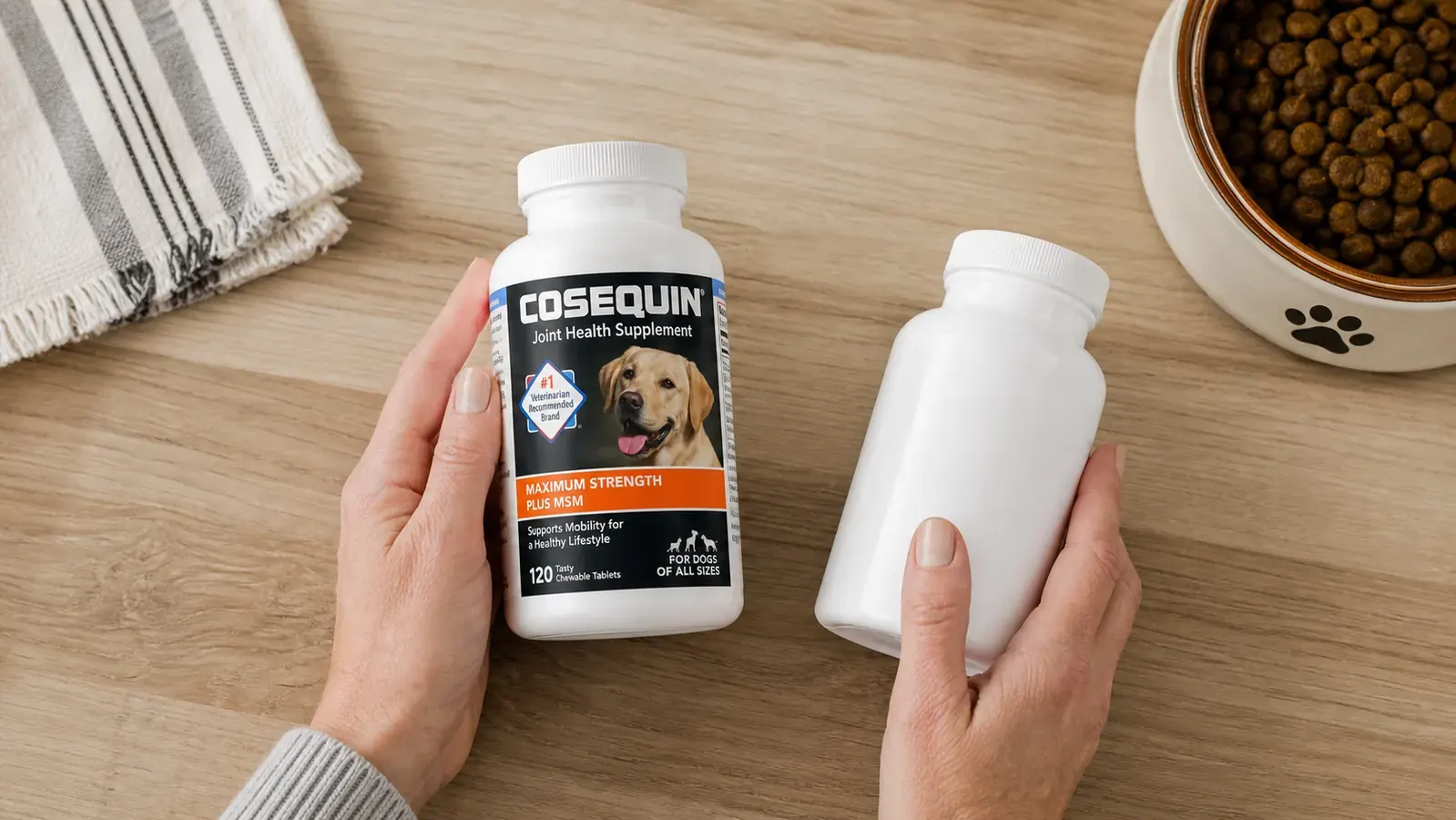
When Bailey started hesitating at the bottom of the stairs last spring, I knew it was time to take joint support seriously. She is an 11-year-old shepherd mix, about 62 pounds, and she had been diagnosed with mild hip dysplasia the year before. My vet had mentioned glucosamine as a first step before talking about prescription options, so I started researching. Two names kept coming up: Cosequin from Nutramax, which has been around since the 1990s, and VetIQ Glucosamine, a much cheaper option with a tidy ingredient label and decent reviews. I bought both and ran them back to back over four months to see what the real difference was.
The short answer: Cosequin is the stronger product, and the reason comes down to ingredients, not marketing. VetIQ is not a bad supplement, and for a young dog with mild occasional stiffness it might be enough. But for a senior dog dealing with real joint deterioration, the formulation gap matters. Here is what the side-by-side looks like in practice.
| Cosequin (Nutramax) | VetIQ Glucosamine | |
|---|---|---|
| Price (typical) | Check today's price on Amazon | Budget-friendly for 180 soft chews |
| Glucosamine per dose | 500 mg (HCl form) | 400 mg |
| Chondroitin per dose | 400 mg | Not included |
| MSM per dose | Not in base formula | 250 mg |
| Manufacturer clinical studies | Yes, Nutramax internal + peer-reviewed data | No published studies |
| NASC quality seal | Yes | Not confirmed |
| Amazon reviews | 78,830+ at 4.7 stars | Fewer than 3,000 at 4.3 stars |
| Palatability / acceptance | Tablet, some dogs refuse it | Soft chew, most dogs eat it readily |
| Vet recommendation rate | Very high, branded as the vet-recommended option | Low, rarely discussed in clinical settings |
Where Cosequin Wins
The ingredient story is where Cosequin earns its reputation. Nutramax is the company that effectively commercialized glucosamine for companion animals, and their formula reflects decades of internal research. Each tablet in the standard formula delivers 500 mg of glucosamine hydrochloride and 400 mg of sodium chondroitin sulfate. That pairing matters because glucosamine and chondroitin work through different but complementary mechanisms. Glucosamine is a building block for cartilage glycosaminoglycans; chondroitin inhibits cartilage-degrading enzymes and helps retain water in the joint matrix. Having both in one product, at meaningful doses, is not just marketing language. The combination has been studied more thoroughly than either ingredient alone.
Nutramax has also published actual clinical data, which is rare in the pet supplement space. Their studies are not independent peer-reviewed trials at arm's length, so take them with appropriate skepticism, but they do show measurable improvement in mobility scores for dogs with osteoarthritis over a 70-day period. VetIQ has no equivalent. When I asked my vet which she trusted more, she did not hesitate: Cosequin was her first recommendation specifically because Nutramax has the data to back up their claims.
The review count is also telling. Bailey is not the only dog on this product. Over 78,000 verified Amazon buyers have rated Cosequin at 4.7 stars, and the most common theme in positive reviews is a before-and-after observation about stairs, morning stiffness, and willingness to go on walks. With that much real-world data, you can reasonably filter out noise and look for patterns. The pattern is consistent: dogs with mild to moderate joint issues tend to show improvement within four to six weeks. I saw that with Bailey. By week five, she was back to trotting up the stairs without stopping.
Where VetIQ Wins
VetIQ's soft chew format is genuinely better for picky dogs. Bailey ate her Cosequin tablets willingly when I buried them in a bit of wet food, but I know plenty of dogs who will find and spit out a tablet no matter what you wrap it in. VetIQ's chews disappear in seconds. If your dog is already a challenge with pills or chewables, the format difference alone might make VetIQ the more practical option, because a supplement your dog refuses to eat has zero efficacy.
The price is also meaningfully lower. VetIQ runs around half the cost per bottle, and for a dog who is younger or dealing with only occasional stiffness rather than diagnosed joint disease, the lower dose and simpler formula may be enough. VetIQ does include 250 mg of MSM per dose, which Cosequin's base formula does not. MSM is an anti-inflammatory compound some vets recommend as an add-on, so if your dog does not have pronounced chondroitin needs, you could argue VetIQ offers a useful tradeoff: a lower glucosamine and chondroitin profile but with MSM included and a better price point.
A supplement your dog refuses to eat has zero efficacy. If your dog is a dedicated tablet-spitter, VetIQ's soft chew format is a real advantage, and that practical reality is worth factoring in before you buy.
Bailey's stairs hesitation is gone, Cosequin is the one I trust for a dog with real joint concerns
Cosequin from Nutramax has the ingredient depth, the clinical backing, and the real-world review track record to be the default choice for senior dogs dealing with joint stiffness or diagnosed dysplasia. Check the current price on Amazon and see the full size options available.
Amazon Check Today's Price on Amazon →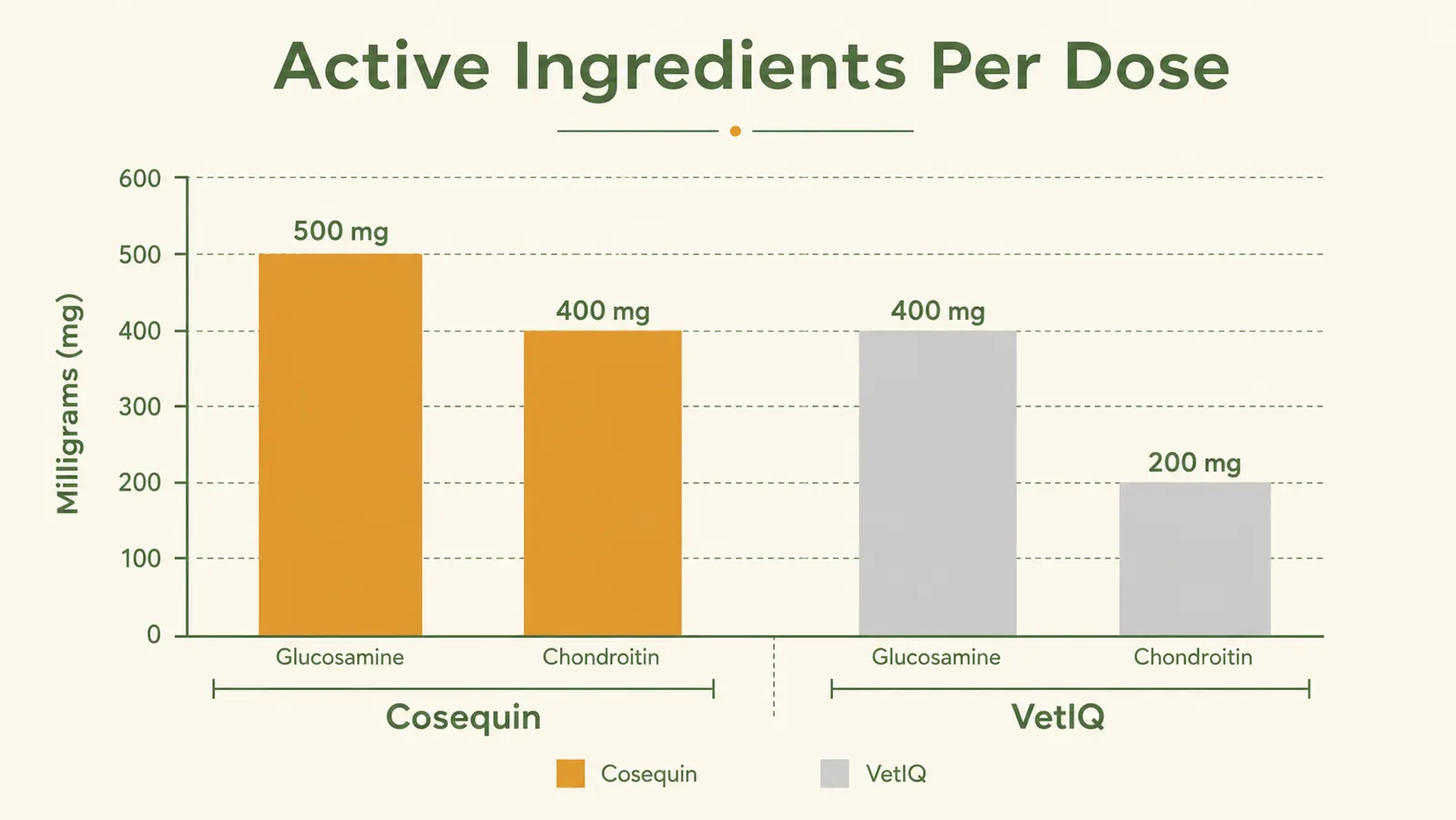
The Ingredient Gap in Plain Language
I want to be specific about the chondroitin difference because it gets glossed over in a lot of comparisons. VetIQ does not include chondroitin. For a young, otherwise healthy dog with mild general stiffness, that may not matter much. But chondroitin sulfate plays a role in slowing cartilage breakdown, not just building cartilage back up. If your dog already has some cartilage degradation, as Bailey does, skipping chondroitin means you are only addressing half the problem. That is the core reason my vet recommended Cosequin over cheaper alternatives: the formula is built around the full picture of joint health, not just the ingredient everyone talks about.
There is also the question of quality control. Nutramax holds a National Animal Supplement Council (NASC) quality seal, which requires a facility audit, adverse event reporting, and label accuracy verification. The pet supplement industry is not FDA-regulated in the same way as human pharmaceuticals, which means a lot of products make claims they cannot support. The NASC seal is not a perfect guarantee, but it is meaningful due diligence. I could not confirm VetIQ holds the same certification, which is a background concern worth knowing about.

Dosing and Daily Routine
Cosequin recommends a loading phase for the first four to six weeks: two tablets per day for medium dogs in the 25- to 75-pound range. After that, you drop to one tablet per day for maintenance. Bailey is 62 pounds, so she started on two tablets and I transitioned to one after six weeks. The initial cost of the loading phase burns through the bottle faster than the label makes it seem at first glance, so factor that into your comparison. VetIQ's dosing is one chew per day for dogs over 50 pounds with no loading phase specified. That straightforward daily routine is slightly more convenient and the soft chew goes down fast.
Neither product produced any digestive upset in Bailey over the course of my trial, which is the main side effect to watch for with glucosamine supplements. Some dogs experience loose stools when first starting, especially during a loading phase with higher doses. I started Bailey on the loading dose with her meal rather than between meals, which seemed to help. VetIQ's no-loading-phase approach means that initial adjustment period is less of a concern.
Who Should Buy Which
Buy Cosequin if your dog is a senior (7 or older for large breeds, 10 or older for small breeds), has been diagnosed with hip dysplasia or osteoarthritis, or is already showing signs of mobility decline, slowing on walks, struggling with stairs, stiff after naps. The ingredient formula is stronger, the clinical track record is real, and the review volume gives you a reliable signal about what to expect. The loading phase costs a bit more upfront, but for a dog with genuine joint concerns it is the better investment. This is the situation I was in with Bailey and Cosequin was the right call.
Consider VetIQ if your dog is younger and active with only mild or occasional stiffness, if cost is a serious constraint, or if your dog categorically refuses tablets. The formula is simpler, the chew format is more palatable, and the MSM inclusion adds a mild anti-inflammatory angle. It is a reasonable entry point for joint support. Just know that if your dog is dealing with more advanced joint issues, you may find yourself switching to Cosequin anyway after a few months of underwhelming results, which is what happens to a lot of the owners I have talked to at the park who started with a cheaper option.
If you want more detail on what six months of Cosequin actually looked like day to day with Bailey, I wrote that up in my full long-term Cosequin review. And if you are trying to figure out where joint supplements fit into a broader approach to senior dog mobility, the step-by-step guide to easing joint stiffness covers the full picture, from weight management to physical therapy options your vet might not mention first.
For senior dogs with real joint issues, Cosequin is the one with the ingredients and the track record to back it up
After four months of direct comparison and six months total with Bailey, Cosequin is the supplement I keep buying. The ingredient depth, the NASC seal, and the 78,000-plus real-world reviews give me confidence that is hard to put a price on when you are talking about your dog's quality of life.
Amazon Check Today's Price on Amazon →